- Location and Map -

 |
||||||
| Monuments and Sites |  Location and Map
 |
|||||
 |
Saqqara |
Monument Overview | ||||
 |
||||||
|
|
|
Unser Tipp für Ihren Urlaub in Ägypten: Buchen Sie Ihre Nilkreuzfahrt oder Ägypten Rundreise direkt beim Rundreise Spezialisten. Engel Reisen stellt Ihnen passende Reisen für Ihren Ägypten Urlaub zusammen! Bereisen Sie Ägypten, das Land der Pharaonen auf einer Nilkreuzfahrt oder erleben Sie Ägypten Total auf einer Ägypten Rundreise mit Kairo, Nilkreuzfahrt und Ägypten Urlaub am roten Meer. Die Nilkreuzfahrten bieten das maximale Kulturerlebnis um Ägypten hautnah und entspannt kennen zu lernen. Ägypten Reisen bucht man günstig bei Engel Reisen: last minute Ägypten, Hurghada Ägypten Angebote finden Sie unter dem jeweiligem Link unseres Vertriebsparters für Ägypten. Suchmaschinenoptimierung von Geniprise designs. Viele Last Minute Ägypten Angebote finden Sie Ihrem Ägypten Spezialist. Buchen Sie Ihre Ägypten Reise Kairo Nilkreuzfahrt baden bei uns und profitieren Sie von unserem Frühbucherrabat. |
|
| The Ancient Egypt Site created by Jacques Kinnaer |
Last update:
25 July, 2009
|
Saqqara is located near the entrance of the Nile Delta, at the point where the river starts dividing into several arms, on the west bank of the Nile. Its first tombs, dated to the beginning of the 1st Dynasty, were built on the ridge of the desert plateau, probably immediately to the west of the new capital of Memphis.
Its northern most monuments, the Archaic Tombs, are located slightly to the south of the 5th Dynasty necropolis of Abusir. It is believed by some that the oldest remains of Memphis are to be found underneath the modern-day village of Abusir, immediately to the east of the Archaic Tombs. To the south, Saqqara borders on Dashur,
which some Egyptologists consider only to have been an extension of
Saqqara. Against this view, however, it must be noted that when the
first pyramids were built at Dashur, in the beginning of the 4th
Dynasty, there was a large area of unexploited desert between the
two sites. The southern-most royal monument at Saqqara was built by
Shepseskaf,
the last king of the 4th Dynasty. |
Saqqara is located to the West of Memphis and was used as necropolis for some 3.000 years. |
|
|
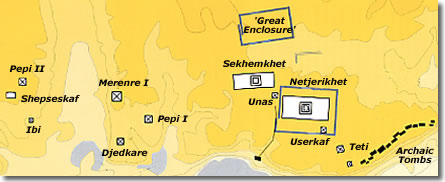
Clickable map of Saqqara. |
|
Throughout its almost 3.000 year long history, Saqqara expanded to cover an area of 6 kilometers from north to south by 1,5 kilometers from east to west. As such, it is one of the largest and most important areas of the Memphite necropolis. This 9 square kilometers area is usually divided into
two parts: Saqqara-North and Saqqara-South. |
||
| Saqqara-North |
||
Saqqara North stretches between the Archaic Tombs just south of Abusir, and the unfinished complex of Sekhemkhet. It can be divided into the following cemeteries:
|
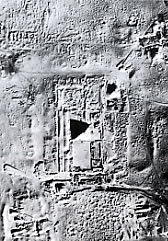
Airview of Saqqara-North, showing the main pyramid complexes, around which several private cemeteries developed over the years. |
|
| Saqqara-South |
||
At some distance to the South of Sekhemkhet's unfinished complex, three kings built their pyramids. The first was Djedkare of the 5th Dynasty, whose attention may have been drawn by the high plateau that dominates this part of the area. He was also the first king to return to Saqqara after several of his predecessors had preferred Abusir, to the North of Saqqara, for their burials. The two other royal monuments built here belong to Pepi I and his son Merenre I, both of the 6th Dynasty. Such was the importance or fame of Pepi I's funerary complex, that its name, mn-nfr was applied to the nearby city of Memphis by later generations. It is possible that during Pepi's time, Memphis, which probably had started out along the East-side of the edge of the Northern plateau of Saqqara, had grown to have its centre located almost directly to the East of Pepi's pyramid. Archaeological research in and around this pyramid, conducted by the French in the 1980's and 1990's has revealed several smaller pyramids that were used for the burial of Pepi I's many queens. Further to the South still the oldest royal tomb that was constructed at Saqqara-South also marks the the southernmost point of the site. The uniquely shaped tomb of Shepseskaf is paralleled only by the tomb of Queen Khentkaus I at Giza, approximately dated to the same period. The penultimate and last royal funerary monuments that were built at Saqqara are the pyramid complex of Pepi II, at some distance to the Northwest of Shepseskaf's tomb; and the small pyramid of Ibi, to the Northeast. Saqqara-South requires much more research for us to better understand not only the evolution of Saqqara as the most important Memphite necropolis, but also of the history of Egypt as a whole. |
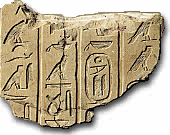
A fragment of the Pyramid Texts found inside the pyramid of Pepi I at Saqqara South. |

 On
a clear day, its most prominent monument,
On
a clear day, its most prominent monument,