
- Meidum -


 |
Pyramid: Base: 144m Height: 92m Slope: 51° 50' 35" |
 |
|
|
|
Unser Tipp für Ihren Urlaub in Ägypten: Buchen Sie Ihre Nilkreuzfahrt oder Ägypten Rundreise direkt beim Rundreise Spezialisten. Engel Reisen stellt Ihnen passende Reisen für Ihren Ägypten Urlaub zusammen! Bereisen Sie Ägypten, das Land der Pharaonen auf einer Nilkreuzfahrt oder erleben Sie Ägypten Total auf einer Ägypten Rundreise mit Kairo, Nilkreuzfahrt und Ägypten Urlaub am roten Meer. Die Nilkreuzfahrten bieten das maximale Kulturerlebnis um Ägypten hautnah und entspannt kennen zu lernen. Ägypten Reisen bucht man günstig bei Engel Reisen: last minute Ägypten, Hurghada Ägypten Angebote finden Sie unter dem jeweiligem Link unseres Vertriebsparters für Ägypten. Suchmaschinenoptimierung von Geniprise designs. Viele Last Minute Ägypten Angebote finden Sie Ihrem Ägypten Spezialist. Buchen Sie Ihre Ägypten Reise Kairo Nilkreuzfahrt baden bei uns und profitieren Sie von unserem Frühbucherrabat. |
|
| The Ancient Egypt Site created by Jacques Kinnaer |
Last update:
25 July, 2009
|
| Location |
||
Meidum is located some 80 kilometres to the South of Memphis, on the Westbank of the Nile, to the East of Lake Moëris and the Fayum oasis. Because of its remoteness, it is not seen as part of the Memphite necropolis, which stretches from Abu Rawash to Dashur, even though one pyramid and several mastabas have been built there during the Old Kingdom. Although Meidum is mainly known for its collapsed pyramid, there also are some impressive cemeteries to the West, North and East of the pyramid. The oldest mastabas that have been found are dated to the early 4th Dynasty, an indication that the site had not been used for burials prior to that. Several of these tombs were built for sons of Snofru, the founder of the 4th Dynasty, among them Nefermaat with his wife Itet and Rahotep and his spouse, Nofret. Two lovely statues representing Rahotep and Nofret respectively were found in their tomb.
|
Meidum is located to the East of the Fayum oasis. |
|
| A map of the cemetery of Meidum,
showing the location of the mastabas related to the pyramid. |
||
A lovely and realistic painting
of six geese in a natural setting, was found in the mastaba of Nefermaat.
The scene shows six gees in a field, three facing left and three facing
right. The geese the most to the left and right are bending over pecking
at the ground for food, whereas the four in the middle have their heads
tilted. The feathering and colouring of the geese is different, breaking
the symmetry in this scene and giving it a very individual aspect. |
||
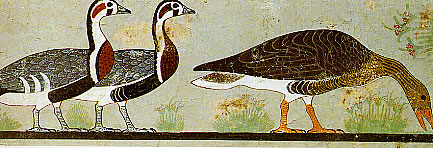 |
Three of the six 'Geese of Meidum'. |
|
| The Pyramid |
||
The pyramid at Meidum marks the transition from the Early Dynastic Period to the Old Kingdom. Following the tradition that was started by the funerary monument of the Horus Netjerikhet at Saqqara, this pyramid was started as a Step Pyramid. With the pyramid of Sekhemkhet at Saqqara and the pyramid at Zawyet el-Aryan credited to Khaba being left unfinished, the one at Meidum was the second large scale Step Pyramid to have been completed. It has often been assumed that the original builder of this Step Pyramid was Huni, the last king of the 3rd Dynasty. This is, however, merely based on the desire to credit at least one major building to this otherwise elusive king. Huni's name has not been found in or near the Meidum Pyramid, making it quite unlikely that this monument was built for him. The fact that the pyramid was named Snofru Endures has led others to suggest that it was Snofru who built this monument. The fact that none of the mastabas surrounding the pyramid are older than the early 4th Dynasty and that several sons of Snofru were buried there also confirms that the pyramid must be dated to the beginning of the 4th rather than the end of the 3rd Dynasty. Recent archaeological research has led to the assumption
that Snofru built this pyramid before his 15th year, and then abandonned
the site to start a new royal cemetery at Dashur, some 40 kilometres
to the North. What is certain is that Snofru at one point during his
reign -and some suggest a high date such as the 28th or 29th year of
his reign- ordered the transformation of the original Step Pyramid into
a true pyramid. It is unlikely that Snofru usurped this pyramid, since
he already had built two other pyramids at Dashur. The reason why this
king would have wanted 3 pyramids, making him the most productive pyramid
builder in the history of Egypt, are not known. It is also not known
whether the conversion of the original Step Pyramid into a true Pyramid
was completed. |
||
Today there is little to suggest that this monument
once indeed was a pyramid. All that remains now is a three-stepped tower
rising up from a hill of debris. It has longtime been assumed that,
while the pyramid was being converted from a Step Pyramid into a true
Pyramid, the weight of the added outer casing was pressing down so hard
that the entire structure collapsed. However, recent archaeological
research has found no trace of tools or equipment that would have been
left behind by the workers, had they actually witnessed the pyramid's
collapse. If this pyramid collapsed, it must have been at a much later
date than was assumed. It is also very likely that this monument, like
so many others, fell victims to local peasants quarrying for stone. |
The remains of the pyramid at Meidum. |
|
 |
3-d reconstruction of the pyramid. |
|
The internal structure of the pyramid is fairly simple, compared to its successors, but at the same time it was an innovation that would become the standard for generations to come. The entrance is located in the north face of the pyramid, above ground level. A descending passage goes down to below ground level and ends in a horizontal passage. Two small chambers or niches open to the left and right of this passage. At the end of this passage, a vertical shaft leads up to the burial chamber, which is located at ground level. This is the first pyramid to have a room inside its actual core. In order to deal with the pressure of the pyramid pushing down on the burial chamber, the builders used the technique of corbelling, with each course of the roof of the chamber projecting inwards as it got higher. The burial chamber measures 5.9 by 2.65 metres, which is quite small, yet another sign that the builders were experimenting. There is no sarcophagus and no trace of a burial. Outside the pyramid many elements that would become the standard for pyramid complexes to come were already present as well. A chapel, measuring 9.18 by 9 metres, was built against its eastern face. To the south, there was a small satellite pyramid. It has an entrance in its north face with a decending passage leading down to the burial chamber. It was already heavily destroyed when it was found. Traces of an enclosure wall, measuring some 236 by 218 metres surrounding this complex have also been found, as well as a causeway, cut in the bedrock and encased in limestone. It is clear that this complex marks the transition from the Early Dynastic funerary complexes to those of the Old Kingdom. The original shape of the pyramid still reflects the 3rd Dynasty tradition, but the building technique, the presence of a satellite pyramid, an eastern chapel and a causeway herald the tradition of the Old Kingdom. |



 Meidum

